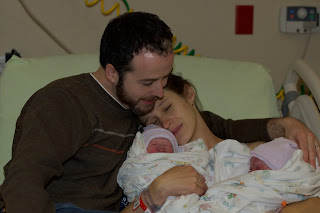
Welcome to the world Esther Tianna Joy and Tivoli Moriah Rain! May God give us the strength and wisdom to raise you to love the Creator, God, who has brought you into this world. Yes! I got my two little princesses! I am so proud of her. Five hours of incredible pain and eight months of carrying the girls through a move across the States and two weeks in Tanzania. I am so blessed by her. Right now I am so grateful for two healthy daughters and wife. God is so good! Born at 36 weeks Esther: Wt - 5 lbs 2 oz, born 8:02am Tivoli: Wt - 5 lbs 6 oz, born 8:20am We were so grateful that my mom could be there to help out. The boys were super excited to meet their new sisters...though before long they were more interested in the grapes brought to Carmen for lunch and all the light switches. Going through the pictures, Carmen and I are having lengthy debates as to who is who. I am convinced that Esther is on the left an...
Tuesday last week I flew out with another MAF pilot, Kirstein, to Haydom. Our schedule was full with flights out to even more remote villages, and we would not return back to Arusha until Friday. On one of the afternoons we needed to haul to the maximum capacity of the aircraft, and so I was left on the ground. As I waited to catch a few pictures of Kirstein taking off to the villages, these two girls kept begging me to take a picture of them so they could see themselves. They were quite pleased, and a little shy, when I showed them my camera screen. After he was off, I began my hike to the large hill beside the town of Haydom. Having grown up in the mountains of Idaho, I miss the tranquility and peace of being in the wild. Being away from busy city life gives me time to think and process. I began to contemplate how different Tanzania is from the world I grew up in. For instance, it took me multiple visits to the Haydom airstrip before noticing the ridicu...
Getting to work has been an adventure of its own. Sometimes I drive, but lately I have been walking or riding my bicycle. It is a great way to go over all the Swahili greetings (there are many) and get some fresh air (or be thoroughly dusted by a large passing vehicle). Many people walk great distances as few own cars and the public transportation does not go everywhere. Below I have taken a video of my bicycle ride to work. I hope you enjoy! Some Blog Changes: I have aimed at keeping up a weekly blog but it is difficult to find the time to continue this aspiration. As such, we will be changing to a bi-weekly schedule. Please let us know if there is anything you are curious about and would like to see a post on! We appreciate your feedback. We want to keep you involved in what we do even though we are half way across the world! Be Praying This week I am in Nairobi, Kenya (four hour drive North), visiting the MAF Kenya team in a day of prayer....
A few weeks ago we found out that the Christian school which Silas and Jason are attending was in need of a principle. Carmen's parents are both teachers and having cross culture experience we mentioned in passing that they should come... We could never have imagined, but they will be coming to Arusha in 10 days! They will be staying in a house that is less than a ten minute walk down the road. At first, this sounded too good to be true, but it is quickly becoming a reality. We will actually have family in Tanzania! This has been a very big step of faith for them and we would encourage you to help them out if you can. Below is their letter with more information. Dear Family and Friends, Recently our work at ProCare Physical Therapy came to an end. With this closing of a chapter in our lives God has opened the door to an exciting new opportunity to serve Him in Tanzania! Moving to Africa in Ten Days! After much prayer and consideration, we have accep...




Comments
Post a Comment